How to Choose Decking Material for a Shaded Deck in Eastern NC
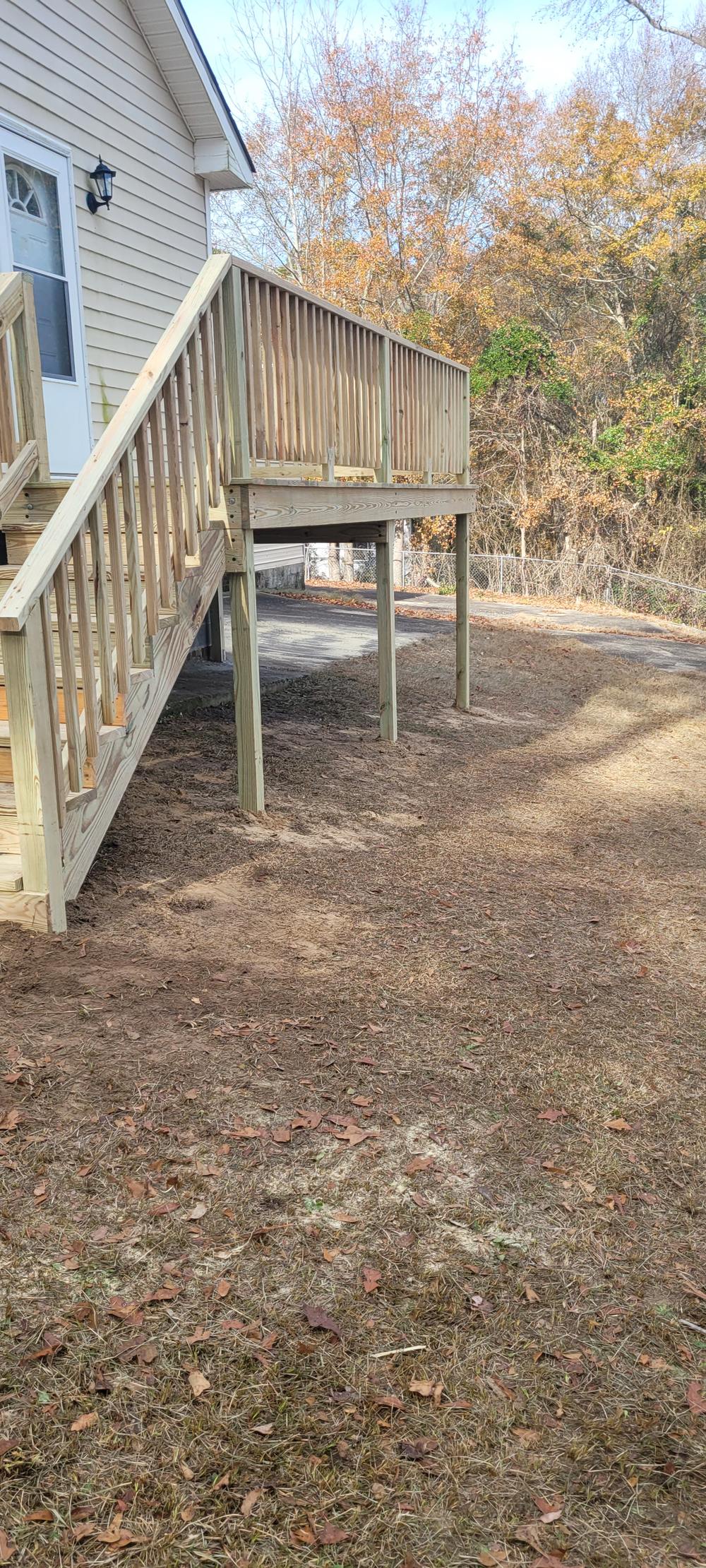
Most people choose decking by standing in an aisle and pointing at a color they like. On an Eastern NC lot, that's the last decision, not the first. The right question is what your property will do to the deck once it's built — and that comes down to three things: the shade, the house line, and what the ground does after a hard rain.
Start with the shade
Shade decides which decking material is worth paying for. It's the single biggest cost driver nobody factors in.
A deck under pines, or tucked against the north side of the house, stays damp long after the rain stops. Wood, composite and metal all behave differently under those conditions. Some surfaces that look great in full sun get slick and green in shade. Some hold grit and pollen in a texture that never quite rinses clean. Boards that sit wet for hours take a lot more abuse than boards that dry by noon, and the material has to be chosen for the wet version of your yard, not the sunny one.
It also helps to notice what falls on the deck. Pine straw, sap, and the tannins that wash out of leaves all leave marks, and some surfaces forgive that better than others.
Look at the house line
The second thing worth studying is how the house is built where the deck meets it. Siding type, how the door sits above the threshold, how much room there is to flash the connection properly, how the band joist is put together.
A lot of deck trouble starts right there rather than out in the middle of the boards. Water that gets behind the siding at the deck line causes damage that has nothing to do with which plank you picked. If the house detail is tight, a modest material performs well. If it isn't, no material saves it.
Watch the ground after a hard rain
Walk out during a downpour, or right after one, and see where the water goes. Does it sheet away from the house, or stand against the post bases? Does it linger for a day in the same low corner?
This matters because decks go wrong in the parts you can't see. Undersized footings heave with the first freeze. Untreated framing rots from the bottom up. Boards spaced for a dry climate cup and hold water here. That's why he builds them the other way — overbuilt underneath, so the surface stays flat and quiet.
Then the material question gets easy
Once those three things are on the table, the conversation is practical. He'll give you a number for the deck you'll actually be happy with, and a cheaper number for the one you might not be. The difference is usually in how the underneath is done, not the color of the surface.
What he aims at is a deck that still feels solid long after it's built: footings sized for the span, framing squared and blocked, joists taped, and decking fastened so the boards can move with the seasons instead of splitting. Boards spaced for our humidity. Railings at a height that actually passes inspection, and wide, low-rise steps down to the yard — easier on knees and kids than the steep, narrow run most decks get stuck with.
If the frame is already bad
Sometimes the honest answer isn't a material at all. If the frame is soft, resurfacing is money thrown away, and the whole thing comes out and starts fresh — often on the existing footprint. There's more on that in the earlier post Deck Repair or Replace? How to Tell If Your Frame Is Still Good. Smaller fixes — soft spots, popped nails, a railing that moves when you lean on it — are worth a look too, and he'll tell you honestly when a repair isn't worth it.
He's Anthony Jones, one contractor, not a call center, working across Farmville, Goldsboro, Greenville, Kinston, New Bern, Pikeville, Snow Hill and Warsaw. Estimates are free and no obligation. Call (252) 253-8352 and describe your yard — the shade, the door, the wet corner — and he'll come look at it.